This project is a simple discrete ring counter in which each stage emulates a thyristor using two transistors.
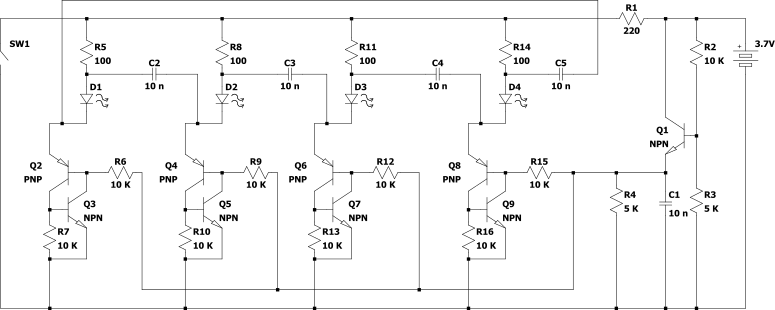
The circuit has four LED stages. Only one LED remains illuminated at a time, and each press of the button moves the illuminated LED to the next stage.
 How does it work ?
The circuit consists of four thyristor-like stages, each controlling one LED.
Each stage uses one PNP transistor and one NPN transistor with cross-coupled feedback. Together, the two transistors reproduce the basic latching behaviour of a thyristor.
Once a stage is triggered, the positive feedback between the two transistors keeps it conducting. The stage therefore remains latched until its current is interrupted.
An important part of the operation is that the stages compete for a limited amount of current.
When the button is pressed, the circuit is temporarily disturbed and the current state of the ring is interrupted.
When a stage changes state, its output produces a short voltage pulse. The coupling capacitor transfers this pulse to the gate of the following stage.
This pulse provides the small trigger needed to start the next stage.
When the button is released, the next stage becomes latched.
The previous stage loses its holding current and switches off, so the illuminated LED moves to the next position.
The sequence therefore continues:
LED 1 → LED 2 → LED 3 → LED 4 → LED 1 → ...
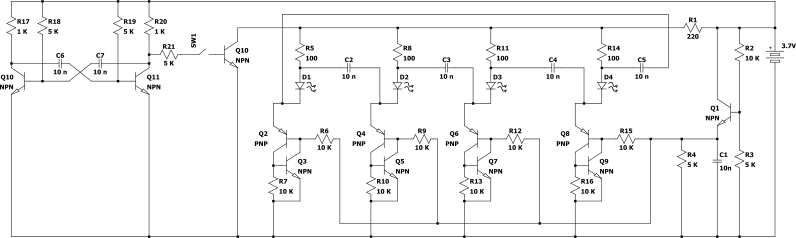
In this version, the switch controls an NPN transistor connected to the ring counter. The base of the NPN transistor is connected to the pushbutton through a resistor and an astable multivibrator.
As long as the button remains pressed, the ring counter continues to advance rapidly through its sequence.
When the pushbutton is released, the connection to the multivibrator is interrupted. The ring counter stops at its current position, leaving only one LED illuminated.
Because the exact moment at which the button is released cannot be precisely controlled, the final LED appears to be selected randomly. The result is therefore a simple electronic dice with a pseudo-random outcome.
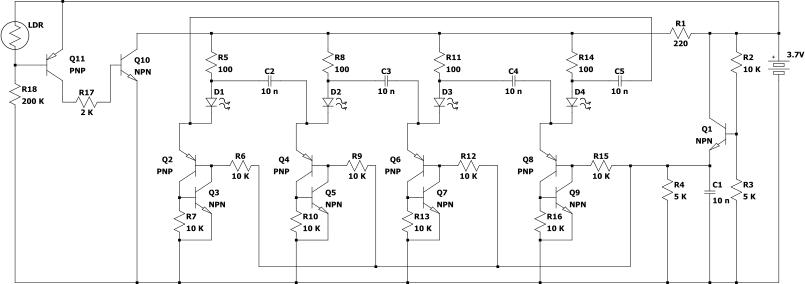
The pushbutton can also be replaced by a simple light-sensitive circuit using an LDR (Light-Dependent Resistor).
The circuit therefore counts each time the light falling on the LDR is interrupted and then restored.
How does it work ?
The LDR controls a PNP transistor, which in turn drives an NPN transistor connected to the ring counter. When the LDR is illuminated, the NPN transistor does not allow current to pass, so the counter is blocked.
When the LDR is no longer illuminated, the change in voltage causes the transistors to switch state. The NPN transistor then allows current to pass.
The circuit therefore advances the ring counter by one position each time the light falling on the LDR is interrupted and then restored.
The ring counter can also be used to drive a 7-segment display. By combining the counter outputs with a simple transistor-based circuit, each position of the ring counter can be associated with a different digit.
Electronics component Fun Kit (with breadboard & power supply module)
General purpose transistors - BC547 (NPN) & BC557 (PNP) pack
Disclosure: As an Amazon Associate, I earn from qualifying purchases. When you click these links to make a purchase, it helps support this website at no absolute extra cost to you.
 INDEX
